|
|
|
|
To create a mathematical model of
the planimeter, you need to describe how the wheel on the moving end of the
planimeter turns. This is because all the planimeter records is the number of
rotations that the wheel has completed. One way to represent this is to define
a vector field in which the vector located at a point  gives the direction that the wheel is rolling in when the planimeter
passes over the point . We show part of this vector field in the following figure.
gives the direction that the wheel is rolling in when the planimeter
passes over the point . We show part of this vector field in the following figure.

The applet below shows the planimeter and the part of the vector field that is nearest the spinning wheel of the planimeter.
 . Since
  points in the direction that the wheel of the planimeter
is moving, gives a scalar multiple of the velocity vector of the planimeter's
wheel. In terms of the planimeter, what interpretation would you assign to
the line integral
points in the direction that the wheel of the planimeter
is moving, gives a scalar multiple of the velocity vector of the planimeter's
wheel. In terms of the planimeter, what interpretation would you assign to
the line integral
 using an iterated integral rather
than a line integral?
using an iterated integral rather
than a line integral?
that describes the planimeter would be expected to be a
scalar multiple of
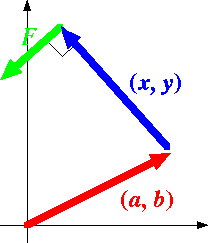
The point  -- the location of the elbow of the planimeter -- can be expressed
in terms of . You will find a command in your worksheet to solve for
-- the location of the elbow of the planimeter -- can be expressed
in terms of . You will find a command in your worksheet to solve for  and
and
 in terms of
  and
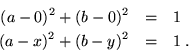
and  . The method is to realize that if the two "arms" of the planimeter
are the same length (say length 1), then the distance formula gives
. The method is to realize that if the two "arms" of the planimeter
are the same length (say length 1), then the distance formula gives
and in terms of and . Use these results to find a symbolic representation for the planimeter
vector field,
. How can you check to make sure that the vector
field you have defined is the right vector field for describing the planimeter?
 . Use your computer algebra system to evaluate and simplify
that expression as much as you possibly can.
. Use your computer algebra system to evaluate and simplify
that expression as much as you possibly can.
|
|
| modules at math.duke.edu | Copyright CCP and the author(s), 1999 |