Multiscale modeling of filamentous protein organization
Parameter inference for models of biophysics experiments
Applied dynamical systems
Applied topological data analysis
State-switching models and emergent dynamics in intracellular transport
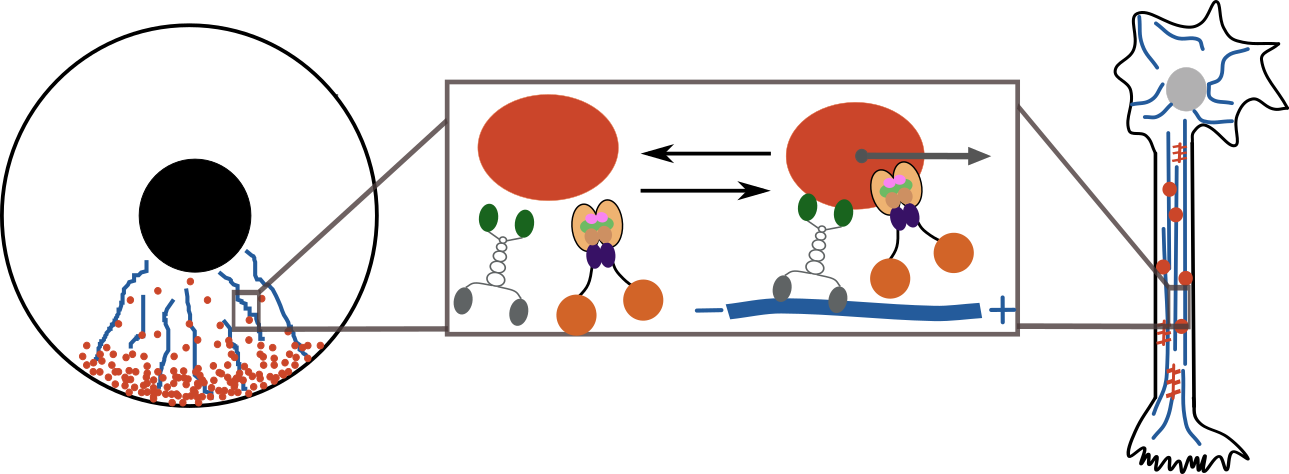
We develop mathematical and computational techniques to uncover the basic functions of intracellular proteins in development and injury. We aim to understand mechanisms of RNA transport in developing frog oocytes and in radial glial cells, as well as study transport of neurofilaments and other proteins in neurons. Our mathematical models rigorously characterize the behavior of proteins that undergo stochastic switching between diffusion, transport, growth and shrinking, etc. inside cells. We develop dynamical systems analysis and numerical simulations of systems of advection-reaction-diffusion partial differential equations as well as analysis of the emergent behavior using stochastic modeling and analysis.
Current collaborators: Kim Mowry Lab (Brown University), Melissa Rolls Lab (Penn State University), Debby Silver Lab (Duke University)
Publications:
MV Ciocanel. Applications of PDEs and Stochastic Modeling to Protein Transport in Cell Biology (Notices of the AMS, 2022) html , arXiv..
MV Ciocanel, J Fricks, P Kramer, SA McKinley. Renewal Reward Perspective on Linear Switching Diffusion Systems in Models of Intracellular Transport. Bulletin of Mathematical Biology, 82(10), 1-36 (2020). DOI , arXiv.
MV Ciocanel, P Jung, A Brown. A mechanism for neurofilament transport acceleration through nodes of Ranvier. MBOC31, No 7 (2020): 640-654. DOI , bioRxiv.
MV Ciocanel, B Sandstede, SP Jeschonek, and KL Mowry. Modeling microtubule-based transport and anchoring of mRNA. SIAM Journal on Applied Dynamical Systems17 (2018) 2855-2881. DOI , PDF.
MV Ciocanel, JA Kreiling, JA Gagnon, KL Mowry, and B Sandstede. Analysis of Active Transport by Fluorescence Recovery after Photobleaching. Biophysical Journal112 (2017) 1714-1725 DOI .
Multiscale modeling and topological data analysis of filamentous protein organization
We develop stochastic and continuous models for the dynamics of microtubules and actin polymers in cells. These studies incorporate biological measurements of filament dynamics and evaluate regulation mechanisms that have been hypothesized in vivo. We are particularly interested in the establishment and re-organization of microtubule polarity in following injury of neurons.
Experimental data from living cells is often complex and requires rigorous analysis and validation of mechanisms. We have thus also been interested in analyzing noisy, spatio-temporal organization of filament structures (either from experiments or from complex agent-based models) using techniques from topological data analysis.
Current collaborators: Melissa Rolls Lab (Penn State University), Adriana Dawes Lab (The Ohio State University)
Publications:
AC Nelson, M Rolls, MV Ciocanel, SA McKinley. Minimal Mechanisms of Microtubule Length Regulation in Living Cells (Bulletin of Mathematical Biology, 2024) DOI, arXiv.
Madeleine Dawson, Carson Dudley, Sasamon Omoma, Hwai-Ray Tung, MV Ciocanel. Characterizing emerging features in cell dynamics using topological data analysis methods (Mathematical Biosciences and Engineering, 2022) DOI .
MV Ciocanel, A Chandrasekaran, C Mager, Q Ni, G Papoian, AT Dawes. Simulated actin reorganization mediated by motor proteins (PLOS Computational Biology, 2022) DOI .
MV Ciocanel, R. Juenemann‡, AT Dawes, SA McKinley. Topological Data Analysis Approaches to Uncovering the Timing of Ring Structure Onset in Filamentous Networks. Bulletin of Mathematical Biology, 83, 21 (2021). DOI , arXiv.
Parameter inference and identifiability for models of biophysics experiments
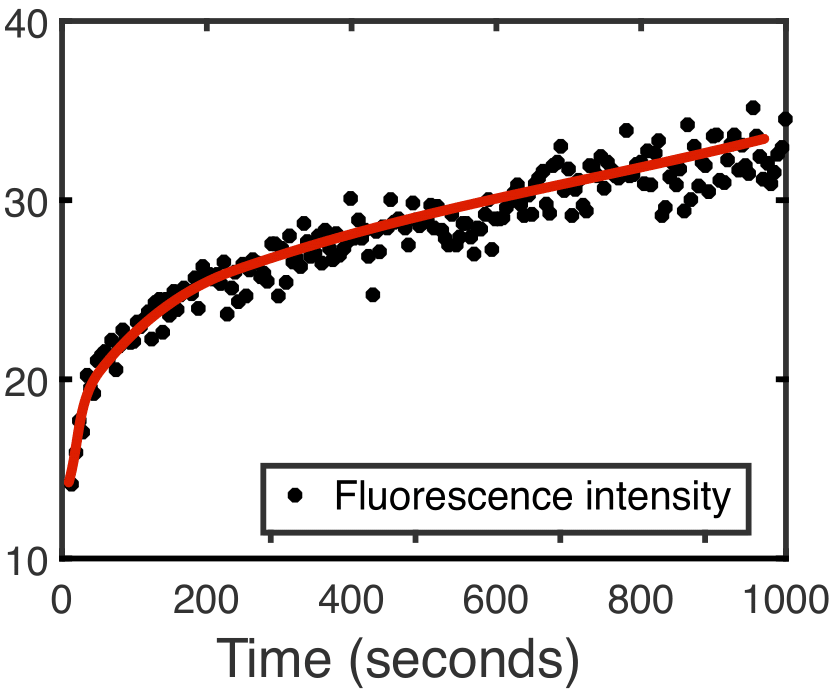
We often connect our mathematical models to data from experimental collaborators by performing parameter inference and uncertainty quantification. In particular, we use deterministic and Bayesian parameter estimation for models of fluorescence microscopy experiments such as FRAP (fluorescence recovery after photobleaching) and photoactivation. Recently, we have been interested in characterizing the identifiability of parameters or parameter combinations in models of protein dynamics in RNA biomolecular condensates.
Current collaborators: Björn Sandstede (Brown University), Kim Mowry (Brown University)
Publications:
MV Ciocanel, L Ding, L Mastromatteo, S Reichheld, S Cabral, K Mowry, B Sandstede. Parameter identifiability in PDE models of fluorescence recovery after photobleaching (Bulletin of Mathematical Biology, 2024) DOI, arXiv.
MV Ciocanel, JA Kreiling, JA Gagnon, KL Mowry, and B Sandstede. Analysis of Active Transport by Fluorescence Recovery after Photobleaching. Biophysical Journal112 (2017) 1714-1725 DOI .
EA Powrie, MV Ciocanel, JA Kreiling, JA Gagnon, B Sandstede, and KL Mowry. Using in vivo imaging to measure RNA mobility in Xenopus laevis oocytes. Methods98 (2016) 60-65 DOI .
I have worked on other projects in mathematical biology, including dynamical systems models of physiology processes, agent-based models of pedestrian dynamics, and machine learning methods for inferring network of interactions of coupled phase oscillators. I continue to study measures of approximate symmetry for pattern-forming systems motivated by cell and developmental biology.
Publications:
P Gandhi, MV Ciocanel, Karl Niklas, AT Dawes. Identification of approximate symmetries in biological development. Philosophical Transactions of the Royal Society A, 379, no. 2213 (2021) DOI .
J Benson, M Bessonov, K Burke, S Cassani, MV Ciocanel, DB Cooney, A Volkening. How do classroom-turnover times depend on lecture-hall size? (Mathematical Biosciences and Engineering, 2023) DOI..
K Mallory†, JR Abrams‡, A Schwartz‡, MV Ciocanel, A Volkening, and B Sandstede. Influenza spread on context-specific networks lifted from interaction-based diary data. Royal Society Open Science 8.1 (2021): 191876.
MJ Panaggio, MV Ciocanel, L Lazarus, CM Topaz, B Xu. Model reconstruction from temporal data for coupled oscillator networks. Chaos29 (2019): 113-116. DOI , Arxiv.
MV Ciocanel, SS Docken, RE Gasper, C Dean, BE Carlson, and MS Olufsen. Cardiovascular regulation in response to multiple hemorrhages: Analysis and parameter estimation. Biological Cybernetics (2018) 1-16. DOI.
MV Ciocanel, TL Stepien, I Sgouralis, and AT Layton. A Multicellular Vascular Model of the Renal Myogenic Response. Processes (Systems Biomedicine)6 (2018), 89 DOI.
MV Ciocanel, TL Stepien, A Edwards, and AT Layton. Modeling Autoregulation of the Afferent Arteriole of the Rat Kidney. Women in Mathematical Biology Springer (2017) 75-100 DOI .
Statistical and computational data analysis of federal sentencing records
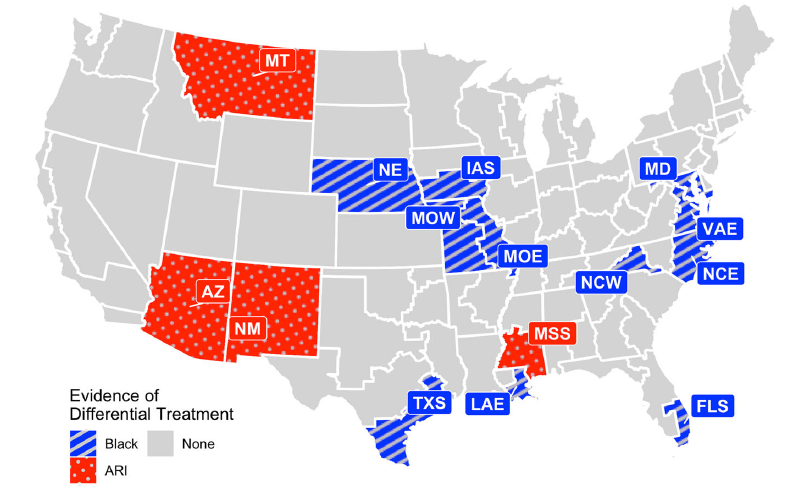
In a multidisciplinary collaboration, we leverage mathematics, statistics and computation to give insights into disparities in the federal sentence system. We used data science and statistical modeling to provide transparent sentencing records and to uncover ways in which racial disparities in criminal sentencing vary across federal judges.
Current collaborators: Chad Topaz (Williams College and QSIDE)
Publications:
CM Topaz, S Ning, MV Ciocanel, S Bushway. Federal Criminal Sentencing: Race-Based Disparate Impact and Differential Treatment in Judicial Districts (Humanit Soc Sci Commun, 2023) DOI.
N Goldrosen, CM Smith, MV Ciocanel, R Santorella, S Sen, S Bushway, CM Topaz. Racial Disparities in Criminal Sentencing Vary Considerably across Federal Judges (Journal of Institutional and Theoretical Economics, 2023) DOI.
MV Ciocanel, CM Topaz, R Santorella†, S Sen, CM Smith, A Hufstetler‡. JUSTFAIR: Judicial System Transparency through Federal Archive Inferred Records. PloS One, 15(10), e0241381 (2020). DOI , SocArXiv.